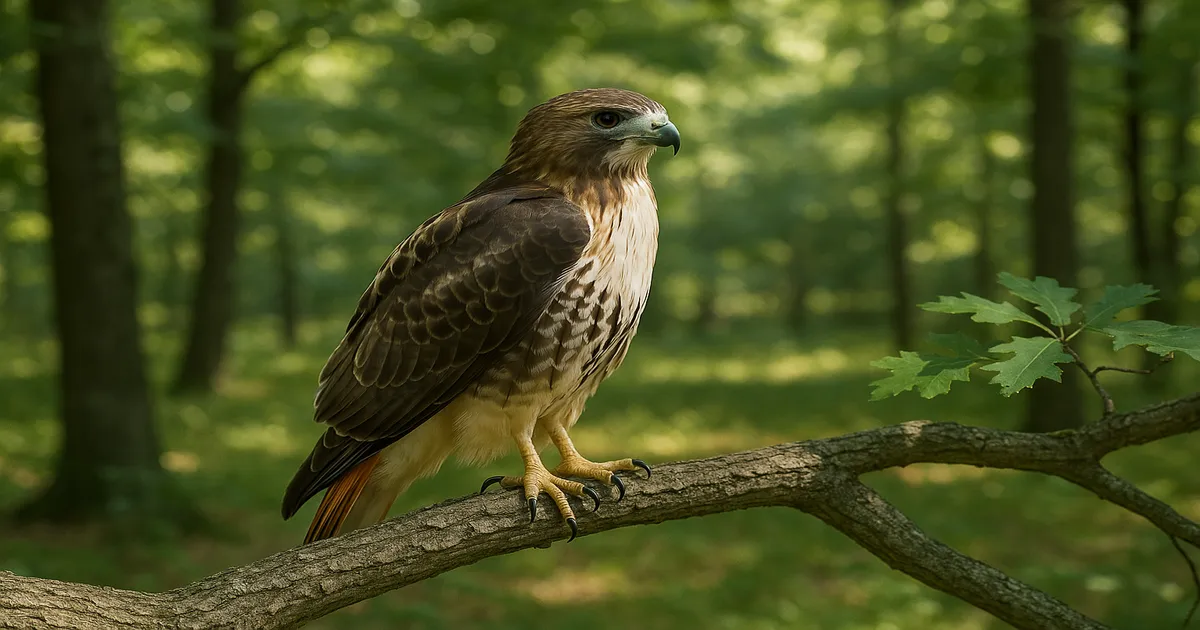
Quick Answer: Adult Red-tailed Hawks (Buteo jamaicensis) are identified by their brick-red upper tail, dark belly band, and dark patagial bars on the underwing leading edge. Juveniles lack the red tail entirely and show a brown, finely barred tail instead. The patagial bars are the single most reliable field mark across all ages and color morphs.
The Red-tailed Hawk is the hawk most North Americans picture when they close their eyes and think “hawk” — and yet red tailed hawk identifying features trip up birders constantly, because this species is far more variable than most people realize. Multiple subspecies, three color morphs, and a dramatic difference between juvenile and adult plumage mean you can encounter what looks like a completely different bird from one week to the next. This guide breaks down every major field mark so you can identify them confidently in the field.
Red-Tailed Hawk Identifying Features at a Glance
The Five Field Marks to Check First
When you spot a large buteo perched on a highway light pole or soaring over a farm field, run through these five marks in order:
- Dark patagial bars — dark brown to blackish bars on the leading edge of the underwing, between body and wrist. Present at all ages and in nearly all morphs. Start here.
- Brick-red upper tail — adults only. Visible from above when soaring or perched.
- Dark belly band — streaked dark flanks and abdomen contrasting with a paler breast, on light-morph birds.
- Broad, rounded wings with a short, broad tail — the classic buteo silhouette.
- Pale pinkish tail from below with a dark subterminal band — adults, when soaring overhead.
Adult vs. Juvenile: The Most Important Distinction
| Feature | Adult | Juvenile |
|---|---|---|
| Tail (above) | Brick red, mostly unbarred | Brown with many narrow dark bars |
| Tail (below) | Pale pinkish, single dark band | Barred throughout |
| Eye color | Dark brown | Pale yellow |
| Belly band | Bold and well-defined | Present but finer, more diffuse |
| Patagial bars | Present | Present — reliable at all ages |
| Overall look | Clean, high-contrast | Streakier, more washed-out |
Plumage Field Marks in Detail
The Rufous Tail: What to Actually Look For
The brick-red or cinnamon-rufous upper tail is gorgeous and unmistakable — when you can see it. From above, it catches sunlight beautifully on a soaring adult. From below, it reads as pale pinkish-buff with a single narrow dark subterminal band near the tip. In flat light from directly below, don’t expect vivid red; look for that pale tail with the dark tip instead.
One caveat worth knowing: the Florida subspecies (B. j. umbrinus) typically retains multiple tail bars even as an adult. If you’re birding peninsular Florida and a bird’s tail looks “wrong,” that’s probably why.
The Belly Band
On a classic light-morph bird, the belly band is one of the best marks when the tail isn’t visible. It’s formed by dark streaking on the flanks and lower abdomen that contrasts with a cleaner, paler upper breast. In flight it reads as a dark horizontal stripe across the midsection. At rest, you can often see it clearly on a perched bird facing you.
Patagial Bars and Carpal Patches
The patagial bars are the field mark I rely on most. They appear as dark, comma-shaped or rectangular patches on the leading edge of the underwing — the section from the body to the wrist — and they hold up across light morphs, dark morphs, adults, and juveniles alike. When a buteo soars overhead and you can’t see the tail at all, check the leading edge of the wing first.
Many individuals also show dark carpal patches at the wrist, complementing the patagial bars and creating an underwing pattern that’s hard to confuse with anything else once you know it.
Upperparts and Head
Light-morph adults show a dark brown back with variable pale mottling on the scapulars. This pale area can form a subtle “V” or saddle visible when the bird is perched or banking — not always obvious, but a useful supporting mark when you see it.
The head is brown with a pale face and throat. Most individuals show a dark malar stripe that gives the bird a slightly stern expression. The bill is short and strongly hooked with a yellow cere. Eye color is one of the clearest age markers: juveniles have pale yellow eyes that darken gradually to deep brown in adults.
Juvenile Red-Tailed Hawks
Tail Pattern in First-Year Birds
Juveniles do not have a red tail. Full stop. Instead, they show a brown tail crossed by numerous narrow, evenly spaced dark bars — it can look almost like a large Accipiter’s tail if you’re not expecting it. This is the most common source of confusion when birders assume every large buteo must have a red tail.
Other Plumage Differences
Beyond the tail, juveniles look generally streakier and less crisp than adults. The belly band is present but tends to be finer and more diffuse. Pale yellow eyes are a great confirmation mark when you can see the bird’s face. The patagial bars still show up well — which is exactly why they’re so useful. Don’t rely on the tail alone.
When Do Juveniles Get the Red Tail?
First-year birds hold their barred juvenile tail through their first winter and spring. After their first complete molt — typically beginning the following summer of their second calendar year — they replace those barred feathers with rufous adult tail feathers. A bird hatched in June will start looking like a proper adult by late summer or fall of the following year.
Color Morphs and Subspecies
Light Morph
The light morph is what most birders east of the Great Plains encounter almost exclusively. Pale underparts, a dark belly band, brown upperparts — this is the bird on every hawk-watching poster. The eastern subspecies (B. j. borealis) is the textbook example.
Dark Morph
Dark-morph birds are almost entirely dark brown to blackish below, which can make them look like a different species entirely. The rufous tail is still present in adults and is often the only obvious clue. Dark morphs are most common in western populations, particularly in B. j. calurus, and are genuinely rare in the East.
Rufous (Intermediate) Morph
The rufous morph sits between the two — heavy orange-rufous streaking below, heavier than a typical light morph but not as uniformly dark as a dark morph. Like dark morphs, rufous birds are primarily a western phenomenon.
Key Subspecies
- Eastern (B. j. borealis): The classic light-morph bird. Migratory in the North, resident in the South.
- Western (B. j. calurus): Highly variable; all three morphs occur, with dark and rufous birds far more common than in the East.
- Florida (B. j. umbrinus): Darker back than borealis, multiple tail bars retained in adults, strictly non-migratory.
- Harlan’s (B. j. harlani): Dark morph–like, with a distinctive whitish tail mottled with gray and black rather than rufous. Breeds in Alaska and northwestern Canada, winters on the southern Great Plains. Sometimes treated as a separate species.
Size, Shape, and Flight
Measurements
| Measurement | Range |
|---|---|
| Body length | 17.7–25.6 in (45–65 cm) |
| Wingspan | 44.9–52.4 in (114–133 cm) |
| Weight | 24.3–51.5 oz (690–1,460 g) |
That’s a wide range, mostly explained by reverse sexual dimorphism (see below).
Male vs. Female
Males and females are identical in plumage — you cannot tell them apart by color or pattern. Females are substantially larger and heavier, most obvious when a mated pair perches together. During courtship flights, the smaller male typically performs the aerial acrobatics while the female watches.
Flight Silhouette and Separation from Similar Species
The Red-tailed Hawk’s silhouette is the mental template most birders use for “generic hawk”: broad, rounded wings and a short, broad tail. When soaring, the wings are held flat or very slightly drooped — worth noting because it’s a useful distinction from Turkey Vultures.
- Turkey Vulture (Cathartes aura): Wings held in a pronounced V-shaped dihedral, not flat. Smaller, wobbly-looking head. Completely different flight style — it rocks side to side constantly.
- Red-shouldered Hawk (Buteo lineatus): Narrower wings, strongly banded tail (not solid red), translucent crescent-shaped “windows” near the wingtips, and no bold patagial bars.
- Rough-legged Hawk (Buteo lagopus): Frequently hovers, shows a white tail base with a dark terminal band, and a dark belly patch rather than a streaked belly band. Winters in open country across much of the U.S.; absent in summer.
- Ferruginous Hawk (Buteo regalis): Larger and paler overall, with a white or rusty tail and a distinctive dark “V” formed by the rufous leg feathers visible from below. No patagial bars.
A good pair of binoculars makes separating these species much easier in the field. (Vortex Optics Viper HD 8x42) For hawk watches where birds are distant, a spotting scope is worth having. (Celestron Regal M2 80ED)
Calls and Vocalizations
The Iconic Descending Scream
The Red-tailed Hawk’s call is one of the most recognizable sounds in North America: a long, hoarse, descending scream — keeeeeeer-r-r-r — that carries remarkably well across open country. Once you know it, you’ll start hearing it constantly. I’ve identified Red-tailed Hawks by ear on foggy mornings when I couldn’t see more than 50 feet, just from that distant raspy scream drifting down from somewhere above the clouds.
Juveniles give a higher-pitched, more wavering version — still recognizable, but with a pleading quality that makes it sound like they’re asking a question. Near the nest, adults also produce shorter, sharper barking calls.
One thing that genuinely delights birders: that screaming raptor call in virtually every Hollywood film? It’s almost always a Red-tailed Hawk call dubbed over footage of a Bald Eagle. The Bald Eagle’s actual call is a weak, high-pitched chatter — not remotely as dramatic. Hollywood borrowed ours.
Sound is an underrated identification tool. Apps like Merlin Bird ID let you compare calls in real time and are worth having on your phone. (Sibley’s Birds of North America App)
Where and When to Find Red-Tailed Hawks
Habitat
Red-tailed Hawks are habitat generalists. They favor open and semi-open country — agricultural fields, grasslands, pastures, desert scrub, forest edges — anywhere they can hunt from a high perch and see the ground clearly. They’ve adapted well to suburban and urban environments too, nesting in city parks and hunting along highway medians. They’re absent from unbroken closed-canopy forest, where hunting from above simply doesn’t work.
Migration and Residency
Northern breeders from Alaska and Canada migrate south from September through November and return February through April. Most of the contiguous United States has resident birds year-round. The Florida subspecies doesn’t migrate at all.
Fall migration — October and November especially — produces spectacular numbers at ridge-top hawk watches. Top sites include:
- Hawk Mountain Sanctuary, Pennsylvania — the classic eastern ridge-top watch
- Cape May Point, New Jersey — excellent coastal concentration in October–November
- Corpus Christi, Texas — a major bottleneck for migrating raptors in fall
Nesting
Courtship starts as early as January in the South. Eggs are laid March–April across most of the range, and young birds fledge in June–July. Pairs are strongly territorial and often return to the same nest site year after year. Great Horned Owls (Bubo virginianus) frequently usurp Red-tailed Hawk nests — the owls nest earlier in the season and simply move in before the hawks return.
Behavior Clues That Help Confirm Identification
If you’re driving a rural highway and see a large, dark bird sitting bolt upright on a utility pole, scanning the roadside ditch — that’s almost certainly a Red-tailed Hawk. Perch hunting from exposed high points is their signature move. They’ll sit motionless for long stretches, then drop in a steep, direct dive onto prey below.
On windy days, Red-tailed Hawks will kite — hovering into the wind with wings spread and tail fanned, essentially stationary in the air — which is a great opportunity to study field marks at leisure. During late winter and early spring courtship, pairs perform spectacular aerial displays: soaring together, the male diving steeply and rising again, and occasionally the pair locking talons and spiraling downward together. It’s one of the better shows in birding, and it’s free.
Frequently Asked Questions About Red-Tailed Hawk Identification
What are the most reliable red tailed hawk identifying features?
The dark patagial bars on the underwing leading edge are the single most reliable mark — present in nearly all ages, sexes, and color morphs. On adults, the brick-red upper tail is unmistakable when visible. On light-morph birds of any age, the dark belly band is a strong supporting mark. Use all three together.
Do juvenile red-tailed hawks have a red tail?
No. Juveniles have a brown tail crossed with numerous narrow dark bars. They won’t develop the rufous adult tail until after their first complete molt in their second calendar year — typically late summer or fall of their second year of life.
What does a red-tailed hawk look like in flight from below?
On a light-morph adult, look for pale underparts with a dark streaked belly band, bold dark patagial bars on the leading edge of each wing, and a pale pinkish tail with a single dark subterminal band. The overall impression is a large, pale-bodied hawk with dark “shoulder” marks and a lightly colored tail.
How do you tell a red-tailed hawk from a red-shouldered hawk?
Red-shouldered Hawks are smaller and slimmer, with narrower wings and a strongly banded black-and-white tail. They show translucent crescent-shaped “windows” near the wingtips — a mark visible even at distance — and lack the bold patagial bars that define the Red-tailed. Red-shouldered Hawks also tend to favor wooded riparian habitat rather than open country.
How do you tell a male red-tailed hawk from a female?
You can’t do it by plumage — males and females are identical in color and pattern. Size is the only reliable field distinction: females are substantially larger and heavier. The difference is most obvious when a mated pair perches together, or when you watch courtship flights and notice the smaller bird (the male) doing all the aerobatics.
A good field guide keeps all of this straight when you’re standing in a field trying to remember whether that tail is barred or not.